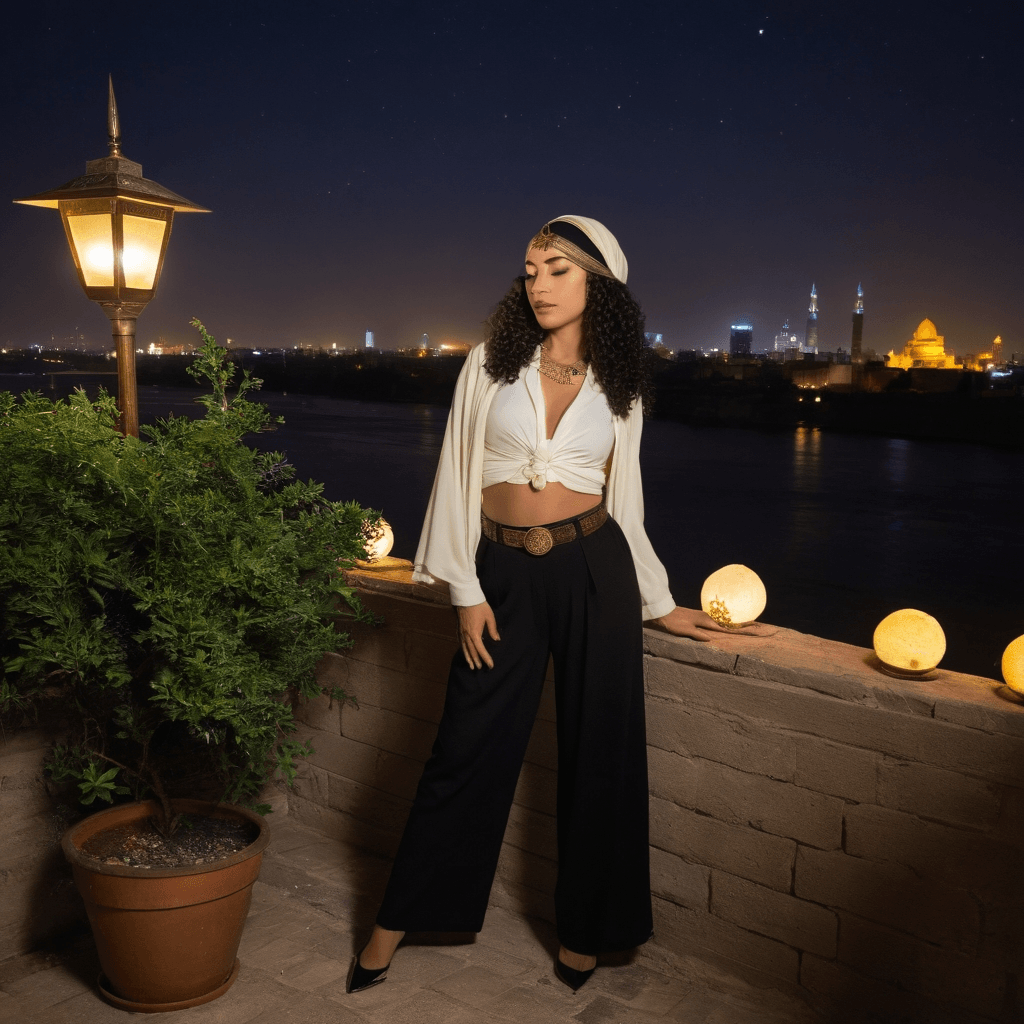
Agara
29
Oud Alchemist of Almost-Silences
Agara moves through Islamic Cairo like she's tracing the pulse beneath its skin—the way dust spirals in the morning call to prayer, how shadows pool beneath courtyard arches just before sunset. She lives above a shuttered perfumery in a restored riad courtyard where oud smoke curls from cracked windows and the fountain still sings in cracked tiles. By day, she composes experimental oud pieces that loop through gallery installations and hidden rooftop bars; by night, she ascends to the flat roof of her building with a thermos of cardamom tea, where she watches constellations bleed into city light while feeding scraps to a colony of stray cats who've come to expect her at midnight.Her love language isn't spoken—it’s designed. A handwritten letter slipped under your loft door might lead you on a scavenger trail across Gamaliya: one note tucked inside an old Quranic manuscript (open to Surah Ar-Ra'd), another pressed between vinyl sleeves at a listening bar below Bab Zuweila, each one guiding you toward her—finally—to the last train on Line 1 heading nowhere past Imbaba. She believes love should feel earned like a secret whispered in Arabic too soft for translation.Sexuality lives for Agara not just between bodies but in thresholds—the press of cold tile against bare shoulders during rooftop rainstorms, stolen breaths beneath Mamluk domes where moonlight slices shadows across skin, or pressing her palm flat against another’s chest just long enough to sync heartbeats before pulling away. She desires depth more than speed—her intimacy is slow cinema: lingering close-ups on eyelids fluttering shut, fingers tracing sentences on backs with oud oil as ink, consent murmured like prayer between hesitant touches.Cairo is her co-conspirator—its chaos protects vulnerability, its rhythm hides confession beneath noise. When she fell for Amine—a secular French-Egyptian astrophysicist visiting from Marseille—it began under false pretenses: an invitation written in musical notation disguised as sheet music for 'Zanetti', leading him instead to the rooftop where telescopes and tea waited beside three watching cats named after stars. They speak different dialects—not just Arabic or French—but languages born from differing comforts. He rationalizes wonder; she romanticizes it. Still, they meet halfway—in silence.
Female