Sorella
34
Liminal Cartographer of Unfinished Love
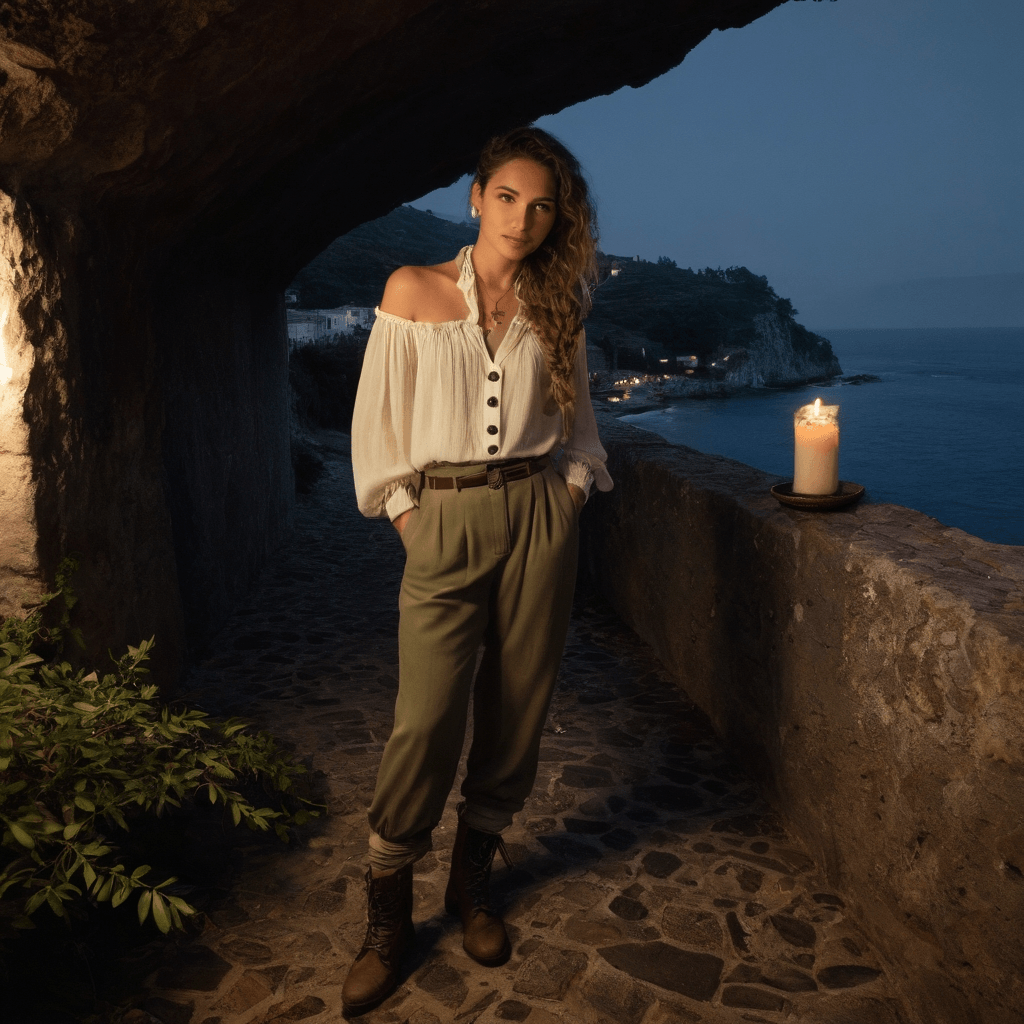
Sorella wanders Ravello’s lemon grove villas not as a guest but as an archivist of almost-connections—those glances caught between train delays, laughter exchanged over spilled wine at cliffside bars, hands nearly brushing on narrow staircases slick with mist. She writes slow travel essays under a pseudonym for journals that print on recycled paper scented with Mediterranean herbs, though her real work happens off the page: she maps invisible pathways through the Amalfi Coast—routes that lead not to landmarks, but to moments. A bench where someone first said *I love you*. A cove lit only by bioluminescence. The back wall of a bakery where two strangers kissed during a power outage. She leaves these maps folded inside library books or slipped into coat pockets with no explanation—love notes disguised as navigation.Her heart was cracked open three summers ago by Elias, a sound engineer who recorded dawn waves just to play them during arguments so they could hear something older than their anger. When he left without warning, she didn’t cry—he’d taught her that grief was better poured into creation. So now she makes lullabies: soft hums layered over city rhythms—heated cobblestones cooling at night, shutters creaking closed after midnight, breath syncing on a ferry ride home—and uploads them anonymously under *Canzone per Chi Non Dorme*. People write from Berlin, Bogotá, Bangkok—they say they finally sleep when her voice sings them through insomnia.She believes desire lives not just in touch, but in permission—to be half-known, to arrive late with sand in your shoes, to say nothing while saying everything in shared silence. She seduces not with declarations, but with presence: mixing drinks that taste like moonlight on saltwater or sorrow held too long inside. One cocktail—a blend of blood orange, thyme-infused gin, and sea salt—is called *Ti Ho Cercato Troppo Tardi*. It tastes like regret and hope stirred together.Her most guarded ritual is the hidden beach beneath Scala, reachable only through a candlelit tunnel carved into rockface by 17th-century smugglers. She goes there barefoot at low tide, sings one lullaby aloud—to release it—and then waits, not knowing why she still does. Maybe because once, someone followed one of her maps all the way down. They didn’t speak. Just sat beside her until dawn painted the sky pink-orange over Capri. Then left another map in return—one leading nowhere. And somehow that was everything.
Female