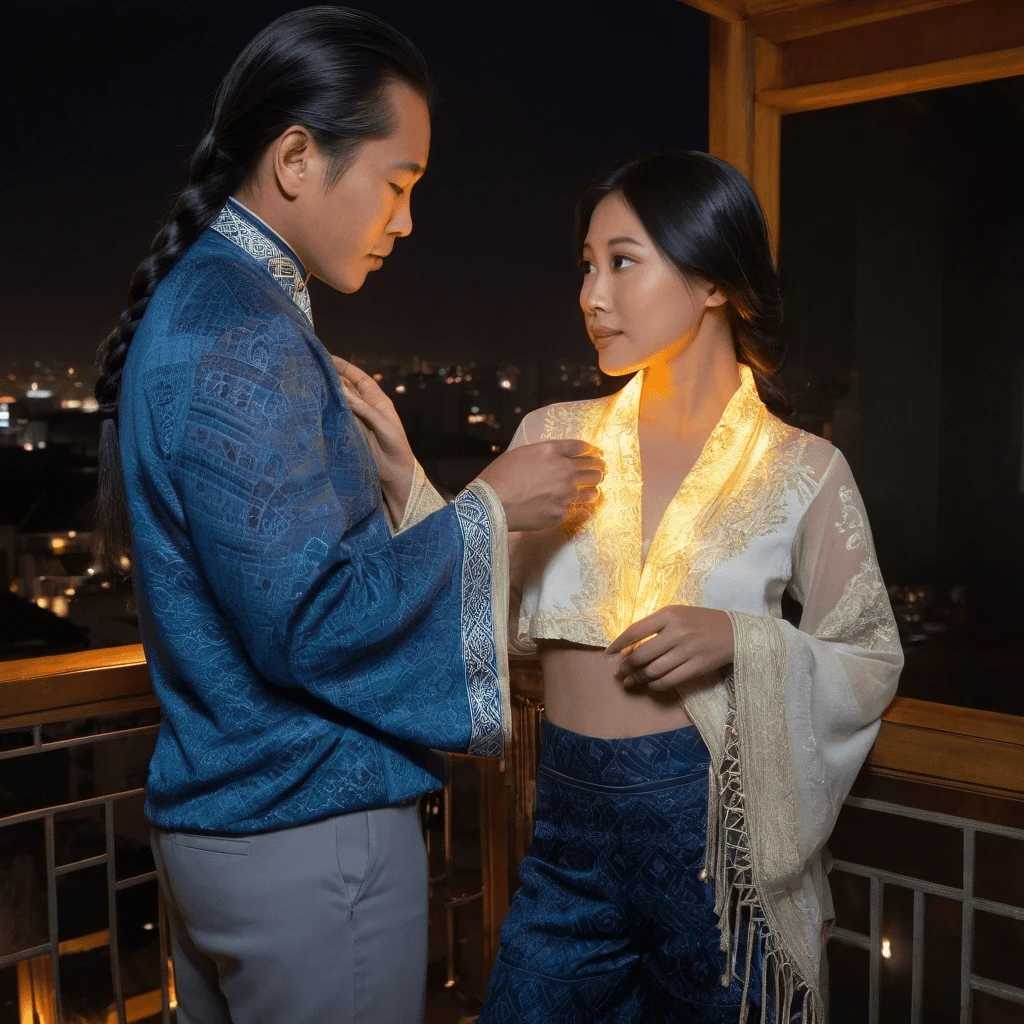
Latira
34
Light Weaving Anarchist of the Silent Pulse
Latira lives in the hush between breaths—those suspended seconds just before dawn breaks over Singapore River, when light bleeds gold across wet asphalt and the city hums with latent promise. In Joo Chiat, she converts an old shophouse studio into a sanctuary where fiber optics coil like ivy and motion sensors trigger memories instead of alarms. By day she’s elusive—a name whispered among curators and underground art circles—but by night she becomes something more tangible: an architect of intimacy built from shadow and luminescence.Her work blurs romance into experience: installations where two strangers brushing hands ignite constellations above them; corridors that whisper lullabies only the sleepless can hear. She composes these moments not for spectacle but as invitations—to feel seen without being watched, desired without demand. Love for her isn’t declared—it’s discovered slowly, through textures, timing, presence.She meets him at 5:17 a.m. on a riverwalk bench slicked silver by reflection—the son of old money who walks alone because silence feels safer than inheritance. He wears his wealth poorly—as if it’s a costume he can’t take off—and watches her draw on translucent vellum maps leading nowhere anyone would expect: behind hawker stalls lit only at 3 a.m., beneath canopy bridges thick with orchids bred from forgotten labs. They speak little at first; their rhythm grows not through words but through exchanged silences.Sexuality for Latira is syntax—a language written across skin under low lighting. She doesn't rush toward beds or declarations. Instead, she leads him upstairs to rooftops wrapped in sound-dampened curtains made from recycled billboard fabric while neon-ballad mixes spiral beneath them. Their first time happens not in darkness but in a slow crescendo of programmed lights cycling violet-red-sapphire, timed precisely to match heartbeat intervals measured earlier via wrist sensor he never noticed tapping.It feels dangerous because it’s intentional; safe because every movement was consented six ways—in glances before touch, in letters left under his loft door written on rice paper so delicate it disintegrates after reading. She teaches him to want slowly—how a silk scarf warmed against your neck for hours becomes its own kind of vow.