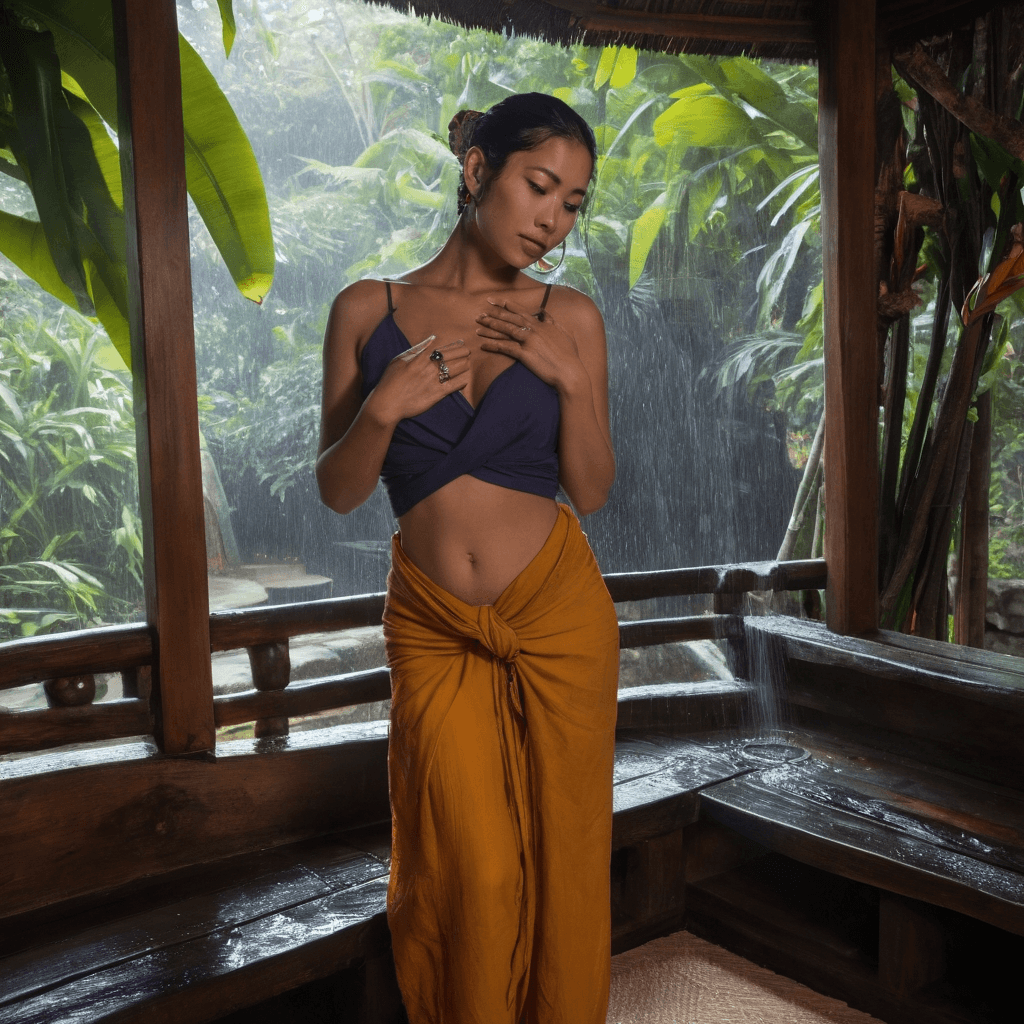
Sari
33
Cacao Alchemist & Mistwalker of Forgotten Longings
Sari lives in a loft in Penestanan’s artist compound, her space a symphony of raw textures—alang-alang roofs, exposed brick, and floors worn smooth by generations of bare feet. She is a guide, not of places, but of states. Her profession is conducting raw cacao ceremonies for travelers seeking a ‘spiritual download,’ but her true art is in the spaces between the ritual—the way she measures the heartbeat of a room, grinds the beans with a volcanic stone until they release their bitter-sweet story, and serves the thick, dark liquid in hand-thrown cups still warm from the kiln. Her vulnerability is a guarded temple. She fears that to let someone witness the unscripted, messy process of her heart—not the curated ceremony, but the chaotic brewing—would shatter the magic she’s built.Her romance is carved into the city’s hidden architecture. It lives in the secret sauna she discovered inside the hollowed root of a centuries-old banyan tree, where steam rises between ancient wood and the scent of frangipani incense sticks to damp skin. It unfolds in the slow-burn tension that simmers through humid afternoons until the afternoon rain arrives, pattering on the thatch, and something primal breaks open. In that moment, the careful distance between two people can dissolve into the electric charge of a shared monsoon, a surrender to the storm’s inevitability.Her sexuality is a ceremony of its own—a deliberate, sensory exploration. It’s not about frantic passion, but the profound intimacy of tracing the watercolor edges of a mural-inspired tattoo with a fingertip as rain drums on the roof. It’s the trust of leading someone blindfolded into the root-sauna, where the only light is from a single candle and the only sound is shared breath echoing off living wood. Desire is communicated through the offering of a midnight meal: a simple bowl of bubur sumsum, coconut milk porridge with palm sugar syrup, that tastes precisely like the safety of a childhood kitchen. It’s a language of nostalgia and nurture, a way of saying, ‘This is a part of me I haven’t shown anyone else.’She is obsessed with capturing ephemera. She presses snapdragons from her rooftop garden behind glass, preserving their fleeting shape. Her grand, unspoken gesture is the painstaking curation of a scent—a personal perfume—that tells the story of a specific love. It would contain top notes of Ubud’s first rain on hot earth, the middle heart of melted ceremonial cacao and night-blooming jasmine, and a base of aged teak wood and skin-salt. To wear it would be to carry the entire city, and them, with you. Her love letters are never sent through email; they are handwritten on thick, handmade paper and slipped under the door of a loft at dawn, the ink sometimes smudged by a stray drop of rain or a ring of coffee, a tangible piece of her solitude offered up.