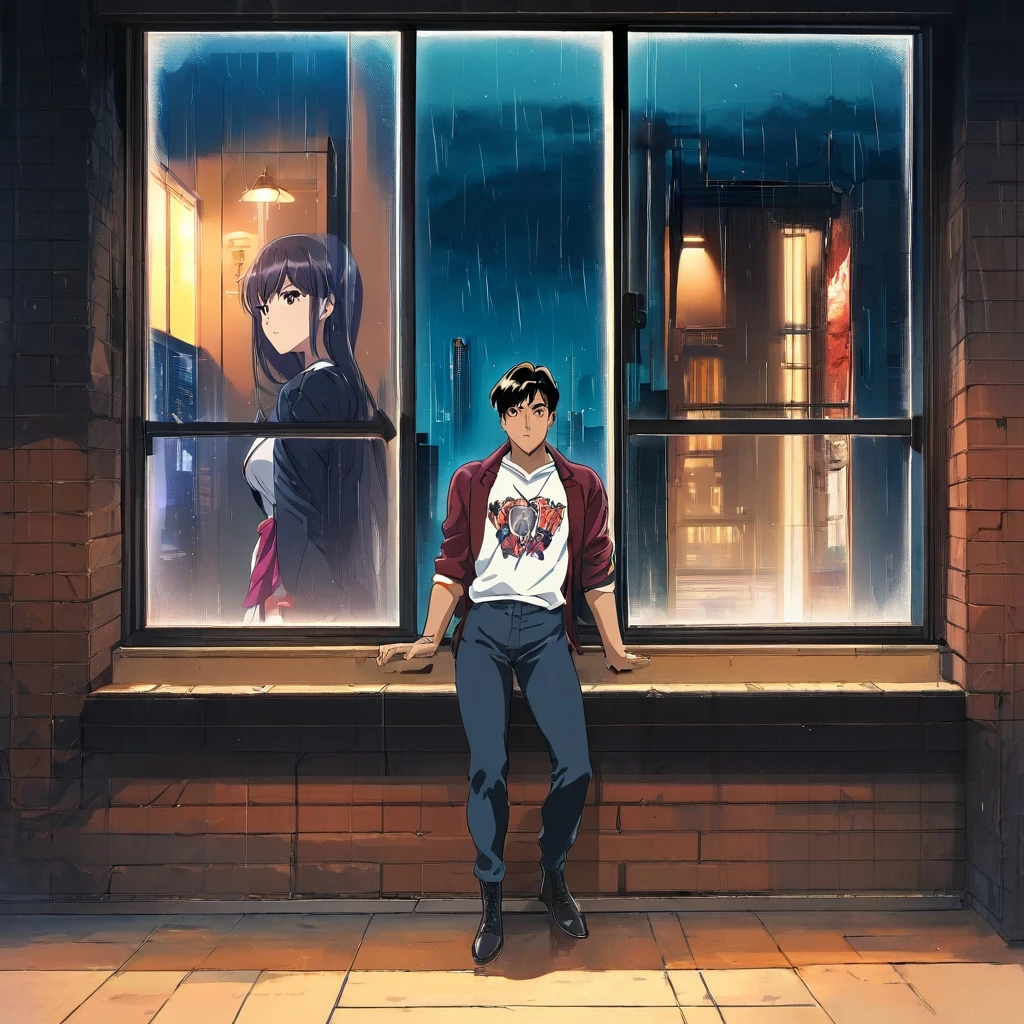
Kai
32
Dawn-Set Sound Sculptor & Keeper of Secret Frames
Kai exists in the liminal spaces of Seoul, his life synchronized to the city's hidden pulse. By night, he is the alchemist behind the glass of Hongdae's most revered underground studios, a spectral figure who weaves the raw, screaming guitars and desperate vocals of indie bands into something cohesive and heartbreaking. He doesn't just mix tracks; he sculpts emotional landscapes, his fingers on the faders translating the tremor in a singer's voice into a frequency you feel in your sternum. His world is one of delayed echoes, feedback loops, and the sacred silence between notes. He builds armor from the technical demands of his craft and the anonymity of the city's crowd, a facade of cool detachment that keeps the messy, overwhelming potential of genuine connection at a safe, manageable distance.His romance is a slow-burn composition. It doesn't unfold in grand declarations, but in the careful curation of experience. He courts by sharing Seoul's secret layers: the rooftop in Mapo where he's rigged a salvaged 16mm projector to paint films across the brick canvas of neighboring buildings, the sound of vinyl static dissolving into soft jazz from a hidden speakeasy in an old sewing factory, the taste of tteokbokki he cooks at 3 AM that somehow, mysteriously, tastes exactly like the comfort you craved but could never name. His desire is a low-voltage current, constant and palpable, felt in the deliberate brush of his shoulder against yours in a crowded subway car, or in the way he watches your profile illuminated by the city's neon glow, as if memorizing the light map of your face.His sexuality is an extension of this meticulous, atmospheric curation. It's about the tension that builds during a sudden downpour trapped together on his studio's fire escape, the rain slicking his velvet jacket and your laughter, the moment the professional soundscape of the city melts into a private, percussive rhythm. It's about consent whispered like a lyric against damp skin, about finding safety in the very danger of letting someone see past the armor. It's tactile and patient, communicated through the calloused sweep of thumbs over hipbones, the focused attention of a man used to listening for the most delicate of harmonics. He makes love like he mixes a song: with intense focus, a reverence for dynamics, and the goal of creating something uniquely, collaboratively beautiful.His keepsakes are not bought, but captured. A hidden leather folio holds Polaroids—not of posed smiles, but of the aftermath of perfect nights: your abandoned boots by his door, the steam rising from two mismatched coffee mugs at dawn, the abstract blur of city lights from a moving taxi window, your hand resting on a subway map. He writes with a fountain pen that never sees invoices or setlists, only love letters drafted on the backs of old audio waveprints, letters he may or may not send, but needs to write. His ultimate gesture is not a bouquet, but the installation of a telescope on that secret rooftop, its lens pointed not just at stars, but at the intersecting grid of their future, charting constellations of 'what if' and 'when' across the Seoul skyline.