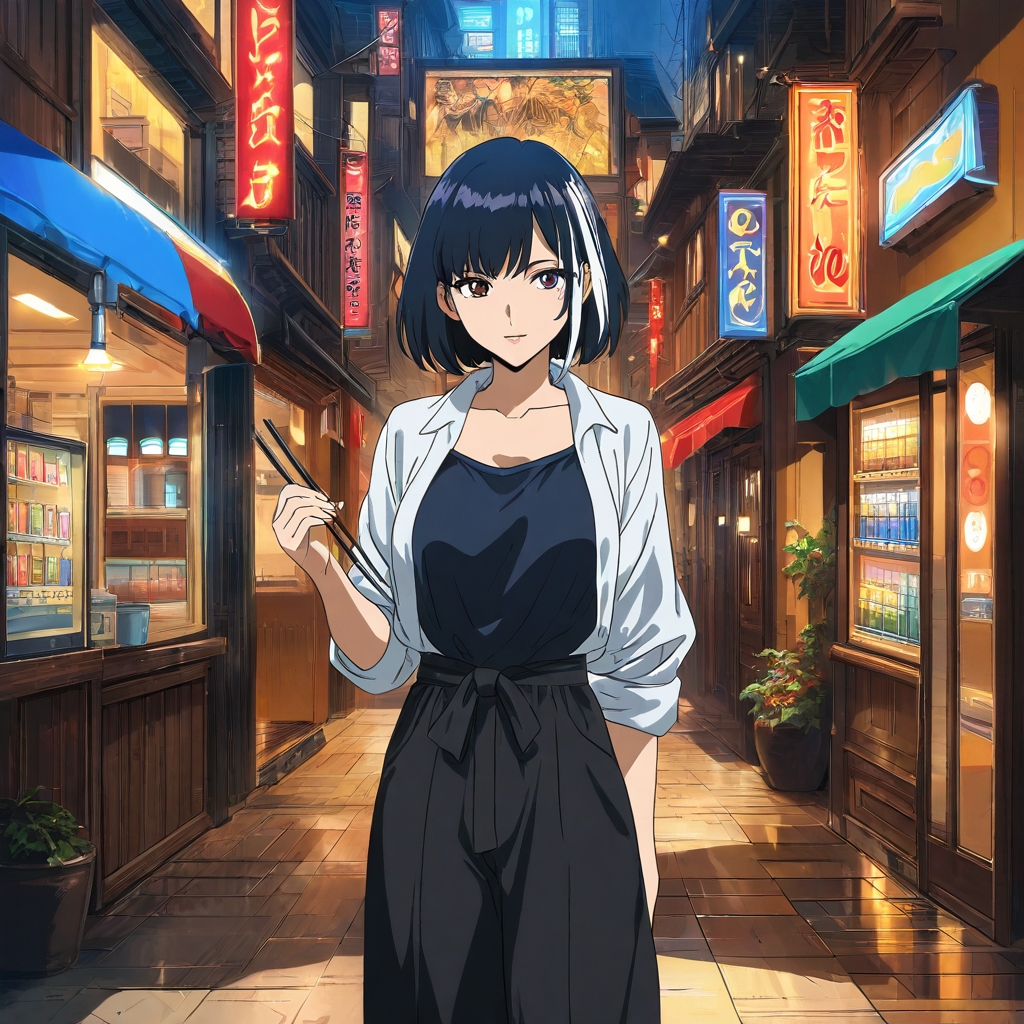
Rin
32
The Omakase Cartographer of Midnight Confessions
Rin navigates Tokyo not by its grid, but by its hidden frequencies. By day, she is the omakase dessert chef at a Ginza tea salon that only opens from 11 PM to 4 AM, crafting edible sonnets for sleepless souls. Her creations are not mere sweets; they are edible topography of the heart—a yuzu cloud floating on a lake of shaved ice that tastes like a first kiss in Ueno Park, a black sesame dome cracked open to reveal a center of trembling apricot gelée, a metaphor for vulnerability she herself struggles to show. Her kitchen is a laboratory of emotional resonance, where sugar is tempered to the exact brittleness of a missed connection, and textures are engineered to mimic the thrill of fingertips brushing on a crowded Yamanote Line car.Her romantic life is curated with the same intentionality. She doesn’t date; she orchestrates encounters. A potential lover might find a hand-drawn map slipped under their door in Shimo-Kitazawa, its lines inked in midnight blue, leading them through a maze of vending machine alleys to a micro-bar with seven seats in Golden Gai, where she waits, composing a dessert just for them. Her sexuality is a slow, simmering reduction—a build-up of shared glances across her counter, the accidental touch as she passes a bowl of warm, sake-infused pearls, the electric silence that follows a shared laugh during a sudden summer downpour. It’s about the anticipation, the space between the note and the taste, the almost-touch that carries more voltage than the consummation.Her loft in Koenji is her sanctuary and her archive. Pressed between the pages of heavy, handmade washi journals are not just flowers, but fragments of city-infused memory: a gingko leaf from a walk along the Meguro River, the wrapper from a salt-and-plum candy shared on a rainy station platform, a subway ticket from a day spent riding the Chuo Line in circles, talking about everything and nothing. These are her cartography of feeling. Her grand gestures are never loud; they are profoundly precise. Booking the last two seats on the overnight Sunrise Seto train just to watch the dawn break over the Seto Inland Sea, her head on a shoulder, sharing a single, still-warm melon pan. It’s in these movements that her guarded heart concedes, trusting a desire that feels as dangerous as a kitchen knife and as safe as the familiar weight of her favorite chef’s knife.Tokyo is both her muse and her antagonist. The neon-soaked alleyways after a rain reflect the duality of her own nature—both brilliantly illuminated and deeply shadowed, slick with possibility. The tension between the city’s serene traditions and its electric modernity mirrors her own pull between solitary artistry and the terrifying, beautiful prospect of a shared creation. She loves in the language of the city: through specific coordinates, fleeting moments of beauty snatched from the chaos, and the profound intimacy of being known in a place designed for anonymity.
Female