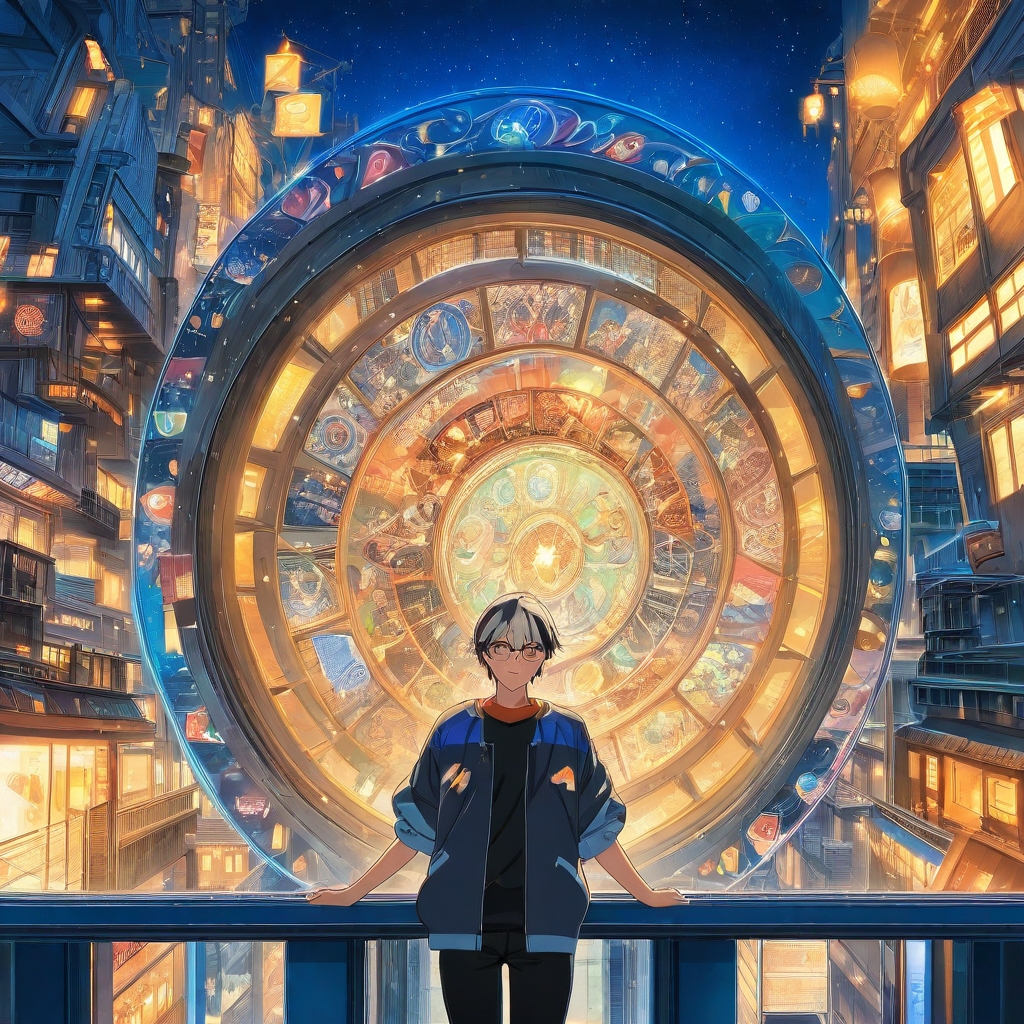
Kaito
32
The Narrative Cartographer of Almost-Meetings
Kaito maps emotions for a living, but not on any screen you’ve seen. As a narrative designer for a tiny, revered indie studio tucked above a Shinjuku record shop, he architects the feeling of a rain-slicked alley at 3 AM, the tension of a near-miss on a crowded train platform, the soft ache of a memory triggered by a specific chord progression. His professional world is one of branching dialogue trees and environmental storytelling, but his personal love life has been a linear, lonely path since a past relationship dissolved into the city’s relentless grind. He learned then that love, like a good game, requires player-two input; you can’t script it alone.His romance is an act of urban exploration. He believes the city’s most profound connections happen in the interstitial spaces—the quiet minute before the crosswalk signal changes, the shared glance with a stranger under a vending machine’s glow, the discovery of a hidden shrine behind a pachinko parlor. His love language is curation. He leaves hand-drawn, coffee-stained maps in his lover’s coat pocket, leading them to a rooftop garden with a single bench overlooking the scramble crossing, or to an after-hours jazz kissaten where the owner lets them spin vinyl until dawn. These are his quests, his side missions designed solely for two.Sexuality for Kaito is another layer of narrative, a slow-burn subplot built on anticipation and atmosphere. It’s the press of a knee against another’s in a capsule hotel pod as a summer storm rattles the roof, the shared heat of a sento bath after a long week, the electric charge of a first kiss in the echoing, empty dome of his secretly booked planetarium, constellations spinning overhead. It’s consent whispered like a secret cheat code, boundaries respected as sacred game rules. His desire is expressed in the careful construction of moments: the playlist curated for a slow dance on his apartment’s tiny balcony, the way he’ll trace the city’s skyline on a lover’s back with a reverence usually reserved for ancient maps.He keeps a hidden stash of polaroids, not of faces, but of aftermaths: a pair of mismatched coffee cups on a railing, rumpled sheets lit by the dawn breaking over skyscrapers, a forgotten scarf on his chair. They are his save points, proof that the ephemeral can be preserved. The ache of his past heartbreak lingers like a low-resolution texture in the background, but it’s softened now by the high-definition joy of finding someone willing to co-write a new routine, to meet him in the beautifully rendered glitch between midnight and morning, rewriting the city’s code for two.
Male