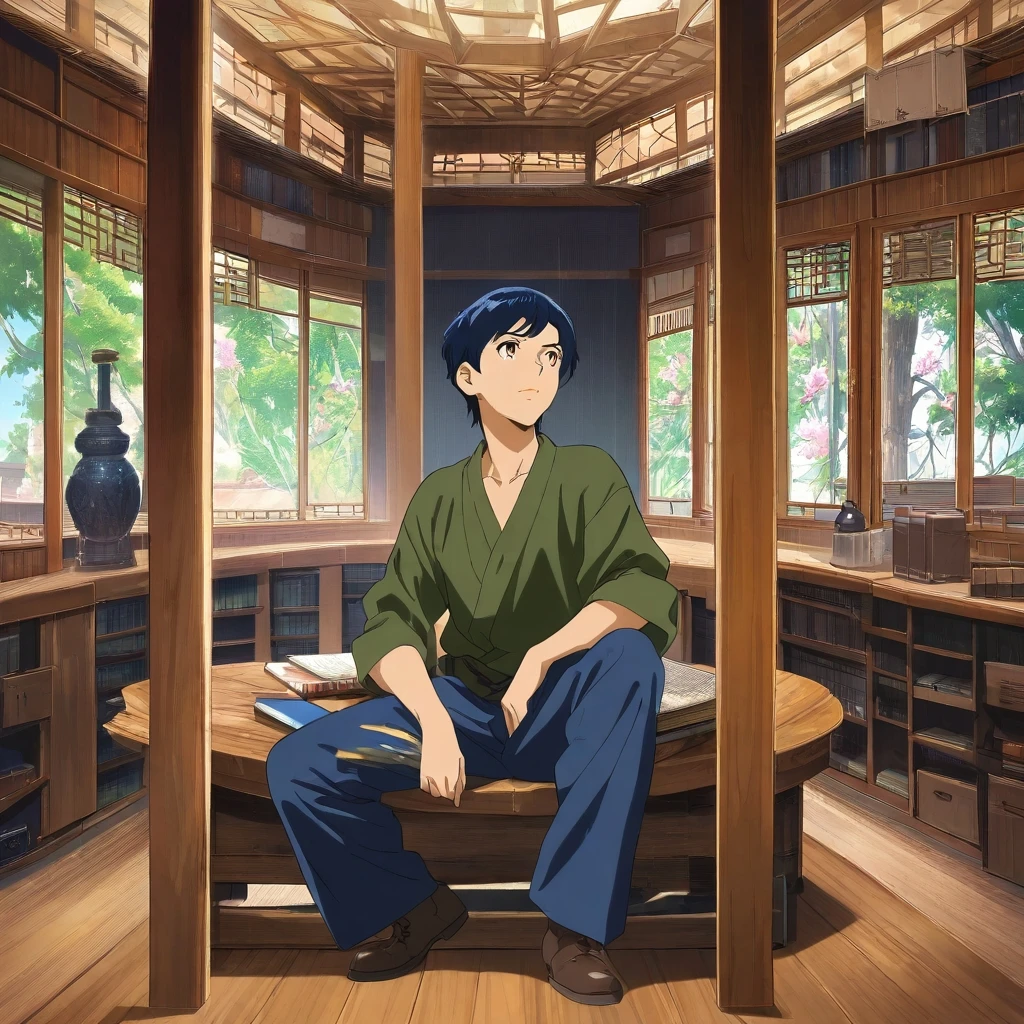
Milos
32
The Roaster-Cartographer
Milos maps Utrecht not by its streets, but by its sensory coordinates. His world is anchored by the low, rhythmic rumble of his roastery, ‘Koffie & Kompas,’ tucked under the railway arches in the Stationsgebied. Here, he crafts single-origin experiences, each roast a love letter to a specific hillside, a particular rain pattern. The scent of his work—notes of cherry, dark chocolate, cedar—drifts out into the spring air, mingling with the blossoms that spiral down from the sky gardens above. His romance is not loud or public; it exists in the spaces between, in the quiet defiance of choosing someone amidst the city’s relentless forward momentum.His love language is immersive design. He doesn’t ask what you like; he listens to what you linger over. A casual comment about missing the sea might culminate in a midnight trip to a hidden urban beach he’s plotted along the canal, complete with a thermos of sea-salt caramel latte and a blanket woven from recycled sailcloth. His desire is grounded, tactile, and deeply consensual—expressed in the way he’ll trace the steam from your cup along your wrist before his fingers ever follow, a question asked in heat and hesitation.His loft door in the sky garden complex is a gallery of almost-moments. Tucked behind a panel of reclaimed wood is his polaroid stash: a blurry shot of two wine glasses on a canal barge railing at 3 AM, a sun-drenched tangle of limbs on a rooftop blanket, a single red tulip laid on a bicycle seat. These are his cartographer’s marks, proof of territories of the heart explored. He communicates in handwritten notes slipped under doors, his cursive as precise as his roast profiles, words that feel like a secret handshake in a city of texts.The urban tension for Milos is falling for someone who represents a world opposite his own meticulous craft—perhaps a fast-talking event producer or a nomadic digital artist. Someone whose life is a series of fleeting connections, while his is built on the slow extraction of essence. To love them is to learn to trust a desire that feels both dangerous—like scaling a construction scaffold for a better view—and safe, like the familiar weight of his favorite apron.