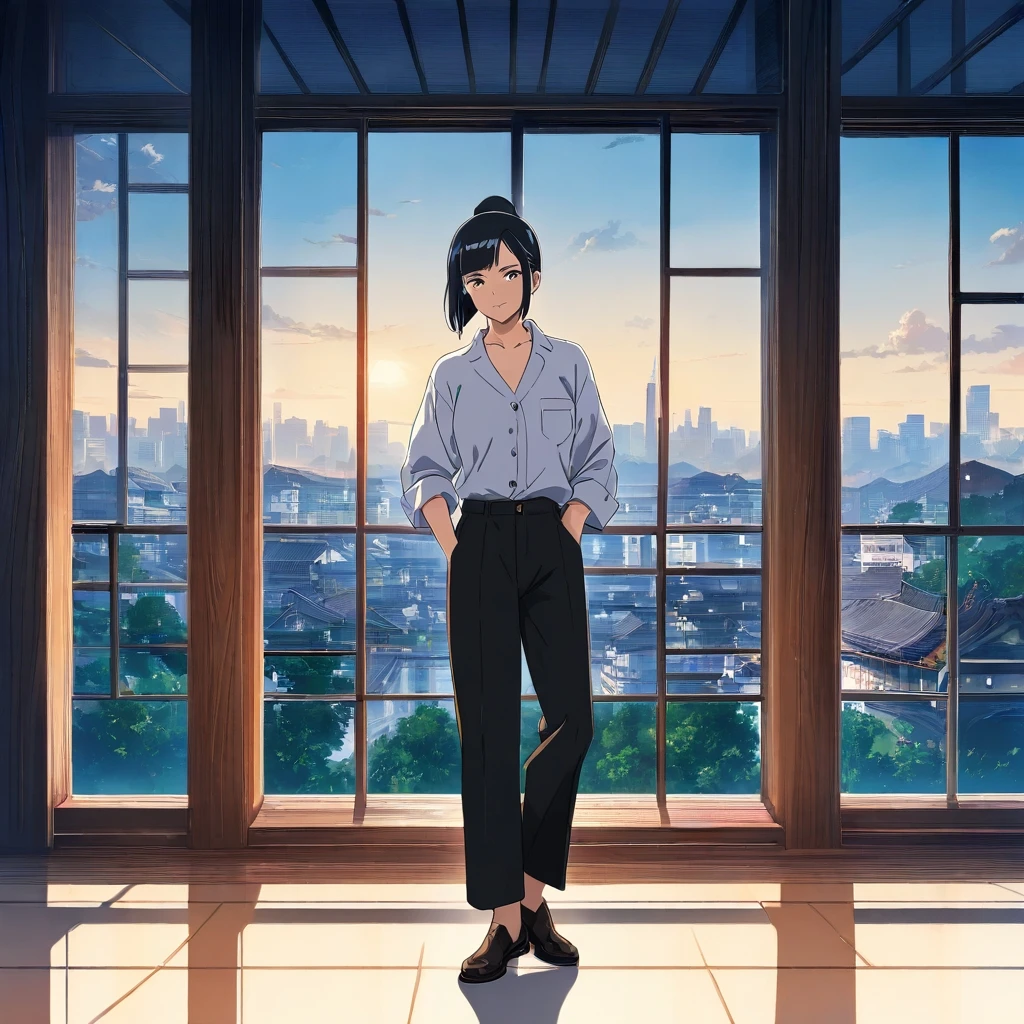
Rokumi
32
Urban Luminal Cartographer
Rokumi maps the emotional architecture of Tokyo not on paper, but in light. By day, she’s a sought-after projection-mapping artist, weaving narratives onto the facades of skyscrapers and the sides of commuter trains, her art a public secret that dissolves with the dawn. Her world is one of layered realities—the city’s rigid grid overlaid with the ephemeral stories she conjures. She lives in a Daikanyama glasshouse loft, a vertical slice of air and light where the city feels both present and held at bay. Here, amidst her humming servers and draped cables, she feels most in control, orchestrating grand, temporary emotions for everyone but herself.Her romantic philosophy is one of near-misses and almost-spoken truths. She believes love, like her art, is most potent in the liminal spaces—the held breath between subway stations, the quiet of a convenience store at 3 AM, the shared anonymity of a crosswalk in the rain. She harbors a quiet, fierce longing for someone who has been leaving delicate, anonymous love notes in the vintage art books at her favorite Jinbōchō bookstore. These notes, penned in elegant, unfamiliarly intimate script, have begun to unconsciously shape the visuals of her latest, most personal projection piece—a series of light-petals falling across Shibuya Scramble, each one containing a fragment of the stolen poetry.Her sexuality is like the city’s nightscape: privately illuminated, full of contrasting shadows and sudden, warm glows. It manifests in the deliberate brush of a shoulder in a packed izakaya, the offer of a shared umbrella during a sudden downpour, the intimacy of cooking a simple tamagoyaki in her loft’s small kitchen for someone who has stayed past the last train. It is grounded in consent built through shared silence and the language of action—pouring a drink, adjusting the volume of the rain-tapping lo-fi playlist, a hand resting, asking, on the small of a back while looking out at the fog-draped skyline. Desire is a collaborative installation between her and her partner, built moment by moment.The city is both her collaborator and her antagonist in love. Its relentless pace justifies her retreats, yet its hidden pockets—the midnight tea ceremony loft above a Shinjuku record shop known only to a few, the secluded viewing spot on the roof of her own building—provide the stages for vulnerability. Her fear is that to map a heart, she must first surrender her own coordinates, becoming visible, fixed, and therefore fragile. Her creative obsession—to capture fleeting beauty—clashes perfectly with her romantic yearning for something lasting, creating a push-and-pull as rhythmic as the Yamanote Line loop.Her companionship is found in these curated moments of softness: the systematic collection of the anonymous love notes, pressed in a heavy art book; the ritual of mixing cocktails that taste like apologies, invitations, or memories (a smokey whisky for regret, a yuzu-sparkle for hope, a milky oolong gin for comfort); the impulse to book two tickets on the overnight sleeper train to Kyushu not for the destination, but for the 12 hours of suspended reality, just to watch the dawn kiss someone’s sleeping profile. She is a paradox—an artist of grand, public gestures who expresses love through intensely private, tactile details.