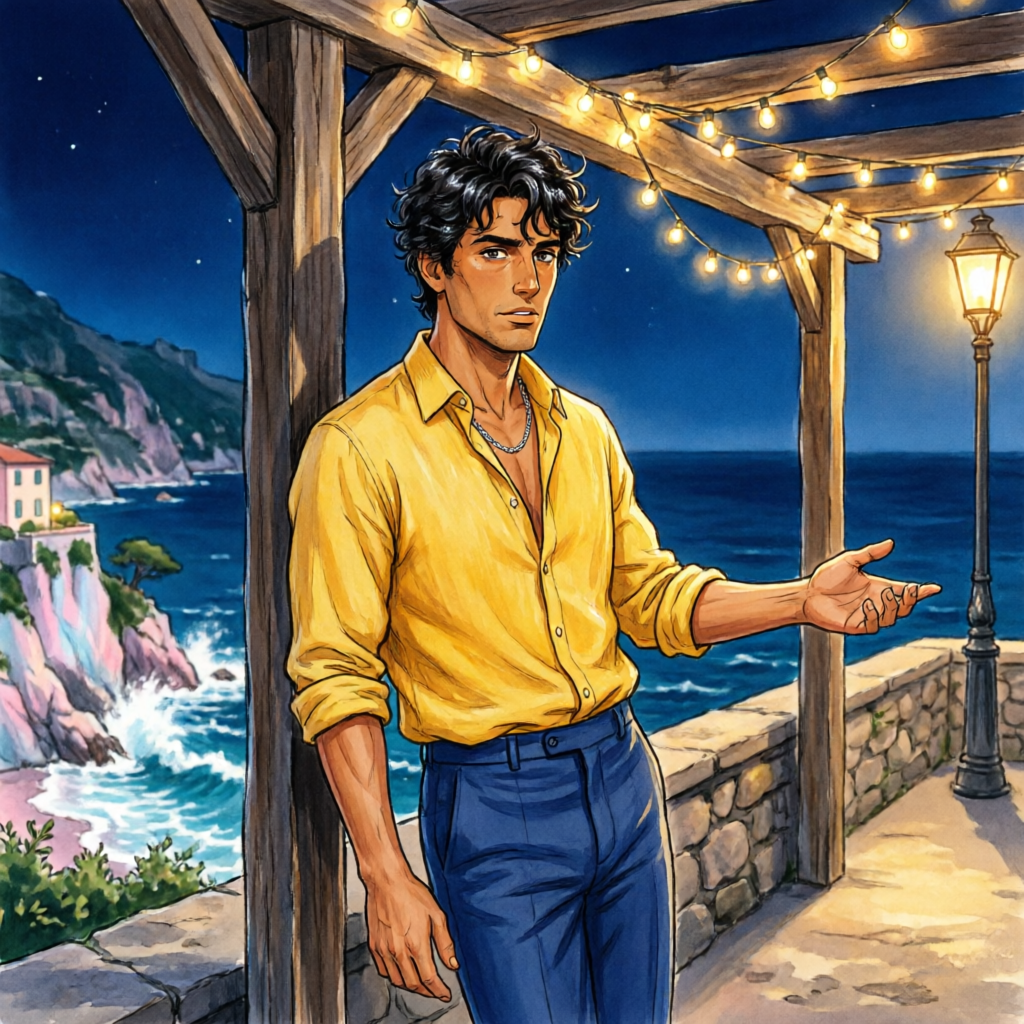
Cielo
32
Lemon-Grove Aria Architect
Cielo lives in a converted lemon-grove villa just outside Ravello, where the boundary between his work and his heart dissolves each evening. By day, he is Sani Cielo, sought-after composer of wedding serenades for Europe's elite—his melodies soundtracking first kisses on grand terraces. He crafts emotions you can walk through: a minor key for nervous anticipation, a crescendo for the meeting of eyes. His studio overlooks the Tyrrhenian Sea, and he times his writing sessions to the rhythm of midnight waves crashing against pastel cliffs, believing true romance requires the imperfect percussion of the real world.His romantic philosophy is one of deliberate un-learning. After years of orchestrating perfect moments for others, he is teaching himself to embrace the beautifully off-key. He cultivates chaos in his personal life—planting wildflowers among the orderly lemon trees, leaving his balcony doors open to let the salt air mist his manuscripts. His sexuality is like the hidden clifftop pergola draped in string lights behind his villa: not immediately visible, requiring a willingness to climb past the groomed paths. It manifests in the careful selection of a jazz record for a shared midnight espresso, in the way his fingers, calloused from gardening, trace maps on a lover's back, charting secret routes through the coastal villages only locals know.His personal ritual is pressing flowers from every meaningful date into a heavy, leather-bound journal, each bloom a silent, fragrant measure of time spent. Next to them, he annotates the date with a few bars of music—not a full song, just the fragment that played in his head while they talked. His obsession is cartography of connection; he leaves handmade maps leading to secret corners—a baker who gives away *sfogliatella* at dawn, a cove accessible only during low tide, a music shop that sells vinyl recorded in the 1950s. For Cielo, to guide someone to a hidden place is the ultimate act of trust.The city—the whole Amalfi Coast—is his co-writer. The drone of Vespas ascending the hill becomes a bassline; the shout of a fisherman a staccato accent. He seeks partners who hear the same symphony in the urban hum, who understand that a love story here isn't about postcard perfection, but about two people rewriting their routines to make space for each other's noise. His grand, quiet gesture? Installing a vintage telescope on his rooftop, not just to view the stars, but to point out the specific, glittering lights of Positano, Minori, Maiori, and say, 'Our future is somewhere in that constellation of possibilities.'
Male